
The Flag-tag peptide, featuring the amino acid sequence DYKDDDDK, is a short and highly versatile peptide tag used in various protein research applications. Its small size, ease of detection, and compatibility with different assay systems make it indispensable for studying protein expression, purification, interaction, and localization. The Flag-tag sequence is typically added to either the N- or C-terminus of a target protein to facilitate detection and isolation in biochemical experiments.
Structure and Chemistry of Flag-tag
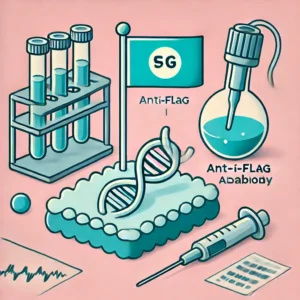
The Flag-tag’s structure consists of eight amino acids, predominantly aspartic acid (D), which helps form strong interactions with anti-Flag antibodies. This sequence allows highly specific binding and detection without significantly altering the protein’s structure. For more information about its chemistry, visit NCBI and NIH.
Applications of Flag-tag Peptide
- Protein Expression and Purification
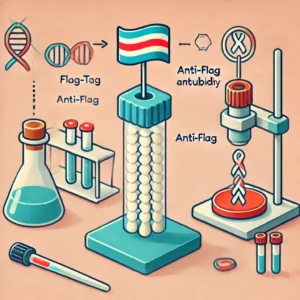
Flag-tag is widely used in recombinant protein purification, enabling researchers to isolate Flag-tagged proteins from complex biological samples using affinity chromatography. Anti-Flag antibodies or resins bind specifically to the Flag-tag, allowing high-purity protein recovery. Read more about protein purification on Harvard University and NIH. - Western Blotting and Immunodetection
Flag-tagged proteins are easily detected by Western blotting. After proteins are separated by SDS-PAGE and transferred onto a membrane, anti-Flag antibodies can be used to visualize the protein of interest. Learn about Western blotting protocols on Stanford University and NIH. - Co-Immunoprecipitation (Co-IP)
Co-immunoprecipitation is a powerful method for studying protein-protein interactions. Flag-tagged bait proteins are expressed in cells and can be pulled down with their interacting partners using anti-Flag antibodies. Detailed Co-IP protocols can be found at NCBI and CDC. - ELISA
In enzyme-linked immunosorbent assays (ELISA), Flag-tagged proteins serve as the capture or detection antigen, facilitating quantification or interaction studies. ELISA protocols involving Flag-tags are available at University of California, Berkeley and CDC. - Live-cell Imaging and Protein Localization
The Flag-tag can be conjugated to fluorophore-labeled antibodies, allowing researchers to track the localization of proteins within live cells. This technique is useful for studying protein dynamics and trafficking. Protocols for live-cell imaging can be accessed on University of Michigan and NIH.
Experimental Considerations
- Tag Positioning
The Flag-tag can be fused to either the N- or C-terminus of a protein. However, tag placement can sometimes interfere with protein function. Researchers should experiment with different configurations to determine the best option for their study. Explore the effects of tag placement at University of Wisconsin-Madison and CDC. - Fusion Protein Stability
The small size of the Flag-tag minimizes interference with protein stability, but in rare cases, it may affect protein folding. Testing different constructs or adding flexible linkers can improve performance. For more information, refer to NCBI. - Flag-tag Cleavage
Some Flag-tag systems include protease cleavage sites to remove the tag after purification. Proteases like TEV protease and Factor Xa are often used for this purpose. More details on cleavage strategies can be found at NIH.
Troubleshooting Flag-tag Experiments
- Low Detection Sensitivity
If the Flag-tagged protein is not easily detected, ensure that protein expression is sufficient, and the antibody used is working optimally. M2 anti-Flag antibody is highly specific and often recommended for optimal results. Troubleshooting advice is available at Stanford University and NIH. - Non-specific Binding
Non-specific binding can occur in immunoprecipitation or affinity purification. Thorough washing and optimized buffer conditions can help reduce this issue. Learn more about preventing non-specific interactions at University of California, San Diego. - Tag Interference
If the Flag-tag interferes with protein function, consider switching to a different tag, such as HA-tag or His-tag, or moving the Flag-tag to the opposite terminus. More on this is available at Harvard University and NCBI.
Future Directions and Advancements
Flag-tag peptide continues to be an essential tool for research in proteomics, drug discovery, and protein interaction studies. With advancements in technologies like CRISPR-Cas9 and single-cell proteomics, Flag-tag systems are being adapted for even more precise studies of protein functions and interactions. Flag-tag’s integration into new areas of research can be explored further at NIH and Stanford University.
Advances in mass spectrometry have also expanded the use of Flag-tags in proteomics, allowing researchers to map complex protein interactions. Researchers can find resources on mass spectrometry and Flag-tag applications at University of California, Davis and NCBI.
Conclusion
The Flag-tag peptide is a highly versatile and effective tool in protein research. Its small size, specificity, and compatibility with various experimental systems make it invaluable for applications like purification, detection, and interaction studies. As new technologies emerge, the Flag-tag remains essential for advancing molecular biology and protein science. For more in-depth protocols and scientific resources, visit NIH, NCBI, and CDC.